

Campbell, Charles

Scottish records show that Charles James Fox Campbell, son of John and Annabella Campbell, was born on 9 January 1807 in Scotland (Campbell 1882).
His family had longstanding ties to Argyllshire. His grandfather, John Campbell, was married to Margaret Fogo and owned the estate of Kinlochlaich in Appin, which he renamed Lochend after selling an earlier property of the same name on Loch Monteith.
His father, John Campbell of Lochend (1771–1827), married Annabella Campbell (1774–1826), daughter of Archibald Campbell of Melfort, at Ardmaddy (Campbell 1882).
After their marriage, John and Annabella lived at Kingsbrough in the Isle of Skye. In 1821, they emigrated to New South Wales with their family, arriving in Sydney on 30 November aboard the Lusitania. Nine of their thirteen children made the journey.
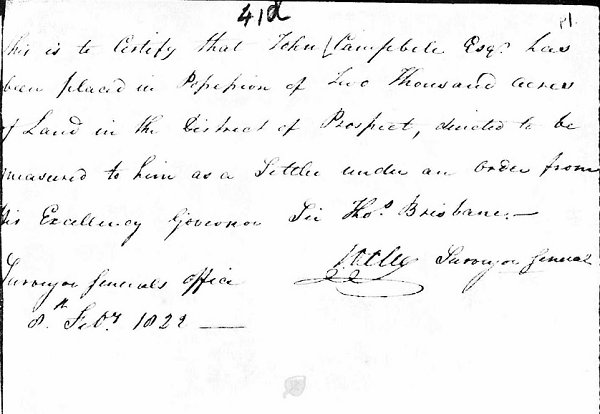
Following their arrival, John Campbell received a substantial land grant west of Sydney from the Governor, Sir Thomas Brisbane, on which the estate of Bungarribee was established.
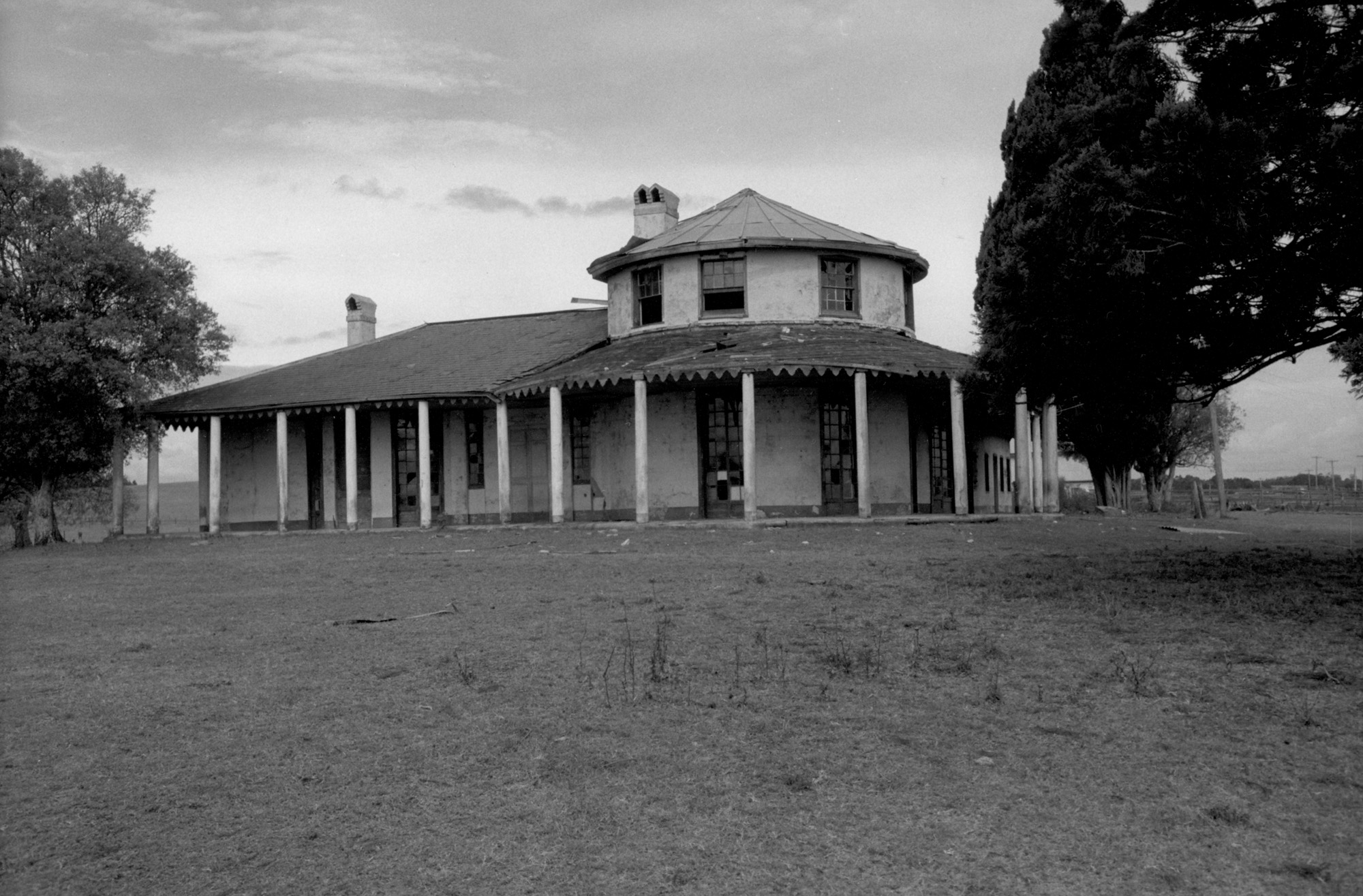
The death of Annabella Campbell at the age of 52 in 1826 was followed less than twelve months later by that of her husband John Campbell, on 10 October 1827, at the age of 56, also at their homestead.
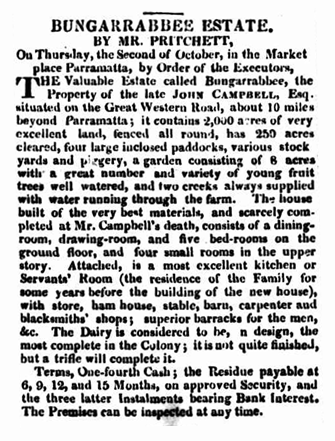
As described in The Sydney Monitor 1828, 'The house, built of the very best materials, and scarcely completed at Mr Campbell's death, consists of a dining room, drawing room and five bedrooms on the ground floor, and four small rooms in the upper storey. Attached is a most excellent kitchen or Servants' Room (the residence of the Family for some years before the building of the new house), with store, ham house, stable, barn, carpenter and blacksmiths' shops, superior barracks for the men, &c.'
The homestead was sold, and the site where the homestead once stood is a public reserve called Heritage Park.
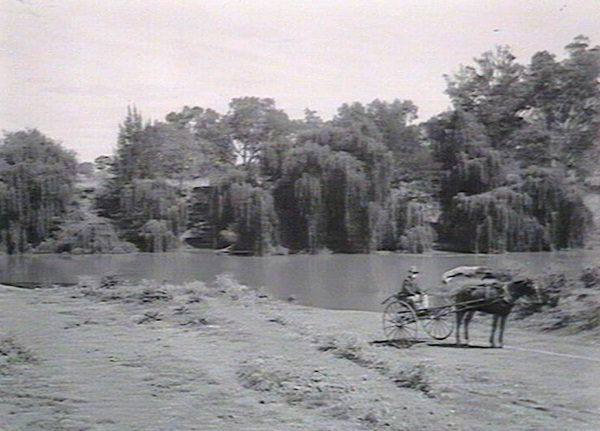
Charles James Fox Campbell established himself as a pastoralist and, in 1836, partnered with his younger brother Dalmahoy to take up a 10,000-hectare squatting run near Dubbo, New South Wales, where they established Dundullimal Homestead. Built in 1840, the house is believed to be the oldest surviving slab hut in Australia. Dundullimal later emerged as a hub for droving cattle and sheep between stations, meatworks, and markets across the nation. Today, the property is heritage-listed and owned by the National Trust of Australia.
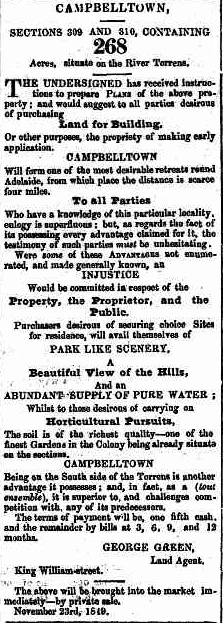
In 1839, James Stein, Evelyn Stuart, Campbell, Hardy and 24 other men made the journey from Bathurst to Adelaide with 5,000 sheep and cattle (Cockburn 1974). Charles Campbell and James Stein jointly undertook further overland livestock expeditions between 1839 and 1840 (South Australian Register 1840). In the early years of the colony, land conveyancing was confusing, and most original deeds were lost (Pike 1961). Other records show that at some time early in the 1940s, Charles James Fox Campbell purchased Sections 309 and 310 from S G Smith and built Lochend on Section 309. In February 1847, the 'Residence of C. Campbell, Esq.' by S.T. Gill was showcased along with another work of the same name by Martha Berkeley, however no images of Lochend House during those years have survived. In 1849, Charles Campbell subdivided section 310, naming it the village Campbell Town. Purchasers were advised they would find 'park like scenery, a beautiful view of the hills, and an abundant supply of pure water'.
In 1850, Charles Campbell married Martha Levi, sister of prominent pastoralist Phillip Levi (Laurence and Weidenhofer 1996). They were the parents of four sons, Phillip Charles John (1851-1902), Frederick Lionel (1852-1911), Edmund Dellahoy (1855-1924) and William Alexander (1857-1947).
By that time, Charles had made himself popular in the social circle of the new colony and maintained a longstanding interest in horses, being involved in horse racing and the Adelaide Hunt (Leaney 1968). By 1849, Charles was offering for sale the only thoroughbred imported horse in the colony (Adelaide Times 1849).
Charles was a close friend and supporter of Captain Charles Sturt, and in 1844 at the public breakfast honouring Captain Sturt, Charles Campbell had a special role as croupier alongside John Morphett, Esq., M.L.C., Edward Stephens, Esq., Manager of the Bank of South Australia, William Giles, Esq., Manager of the South Australian Company, and G. F. Aston, Esquire (South Australian Register 1844).
Charles was active in public life as Justice of the Peace, Worshipful Master of the Lodge of Friendship and a Provincial Grand Officer (South Australian 1848). He brought life to many occasions and Lieutenant Governor Sir George Murray shared an amusing story that Charles 'was a very strong man, and it is related that on one occasion he challenged a man to a 100 yards race on the terms that he himself was to run the first 50 yards and carry a pony the rest of the way, while his opponent ran the whole distance. It was said that Mr Campbell won.' (Observer 1928).
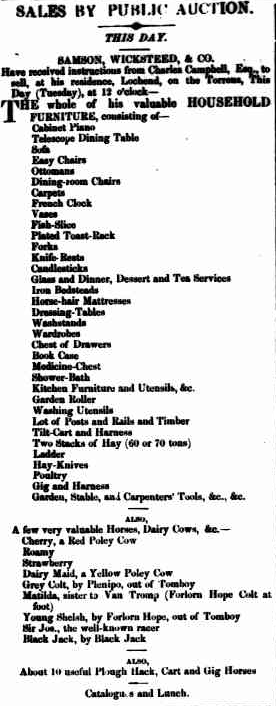
In 1852, Lochend was leased to James Scott of Para Station in NSW (Leaney 1968) and the Campbell household items were advertised for sale (South Australian Register 1852).
Between the years 1852 and 1856, Charles Campbell offered the services of storage facilities in Flinders Street, Adelaide (Leaney 1968), and in 1858, Charles Campbell and his family moved to Nor'West Bend Station on the Murray River near Morgan.
Nor’West Bend Station was a 935 square kilometre property purchased in 1853 by Martha’s brother, Phillip Levi (1822-1898). While there, Charles took on the responsibilities of station manager.
In 1859, the Adelaide Observer reported: 'Charles James Fox Campbell recently met with what at the time seemed a trifling accident, but which is now threatening to be a serious affair. It appears that a slight injury on the hand from a piece of broken glass caused so much inflammation in the arm that it has been thought desirable to get Dr Gosse to go up to the Murray without delay.'
Charles died 5 March 1859 after contracting erysipelas following the cut to his hand. He was briefly interred on Nor’West Bend Station and then removed to West Terrace Cemetery.
Charles enjoyed a wide circle of friends and was warmly remembered for his kindly disposition (Adelaide Observer, 1859). His funeral procession was notably large, comprising a hearse drawn by four horses followed by twenty carriages. The cortege proceeded through North Adelaide, along King William Street, Currie Street, Light Square, Weymouth Street, and West Terrace, before reaching the Cemetery, where the coffin was placed in a vault. Among the mourners were His Honour Sir Charles Cooper, Chief Justice; His Honour Mr Justice Gwynne; the Hon. J. H. Fisher; the Hon. John Morphett; the Hon. Dr Everard; Captain Watts; John Brown; Hurtle Fisher; J. Beck; E. Bagot; H. Morris; J. Hallett, M.P.; C. S. Hare; G. Green; Arthur Hardy; Alfred Hardy; James Chambers; and W. H. Clark ( South Australian Register, 1859).
Although his time in South Australia was brief, Charles James Fox Campbell left an enduring legacy. The suburb of Campbelltown, along with the local government district now known as the City of Campbelltown, was named in his honour.
References
(1828) 'Sales By Auction Bungarribee Estate By Mr Pritchett', The Sydney Monitor, 20 September, p. 8, accessed 2 December 2025.
(1840) 'More Stock Overland', South Australian Register, 29 August, p. 2, accessed 2 December 2025.
(1844) 'Public Breakfast To The Hon. Captain Sturt.', South Australian Register, 14 August, p. 3, accessed 2 December 2025.
(1848) 'Local News.', South Australian, 29 December, p. 3, accessed 2 December 2025.
(1849) 'Forlorn Hope', Adelaide Times, 19 March, p. 1, accessed 2 December 2025.
(1849) 'Prospectus of the South Australian Railway Company', Adelaide Times, 2 July, p. 1, accessed 2 December 2025.
(1852) 'Sales by Public Auction', South Australian Register, 1 June, p. 1, accessed 2 December 2025.
(1859) 'Serious Accident', Adelaide Observer, 5 March, p. 2, accessed 2 December 2025.
(1859) 'Death of Mr Charles Campbell', Adelaide Observer, 12 March, p. 3, accessed 2 December 2025.
(1859) 'Funeral of the Late Mr Charles Campbell', South Australian Register, 22 March, p. 3, accessed 2 December 2025.
(1928) 'Old Time Jury', Saturday Journal, 14 July, p. 1, accessed 2 December 2025.
(1928) 'Campbelltown Memories', Observer, 10 March, p. 62, accessed 2 December 2025.
Campbell M (1882) A Memorial History of the Campbells of Melfort, Argyllshire, accessed 2 December 2025.
Cockburn R (1974) Pastoral pioneers of South Australia, Lynton Publications, Blackwood.
Colonial Secretary’s Papers (1822) Excerpt mentioning John Campbell [photograph], accessed 2 December 2025.
Irvine R (2018) Colonial Settlers on the River Torrens, Wakefield Press, Adelaide.
Laurence S and Weidenhofer T (1996) Heritage Survey of the City of Campbelltown, City of Campbelltown Department of Environment and Natural Resources, Adelaide.
(No date) Dundullimal Crossing, Macquarie River [photograph], accessed 2 December 2025.
Pike D (1961) Introduction of the real property act in South Australia (PDF), Adelaide Law Review; 1(2): pages 169-189, accessed 2 December 2025.
Wollaston B (1954) Bungarribee Homestead NSW [photograph], accessed 2 December 2025.