

Wasps and bees
Bees and other pollinating insects such as butterflies, moths, native beetles and native wasps are important to our gardens, plant-based industries and the health of our ecosystems.
Seeing a few wasps flying in and out of a hole in the ground or retaining wall, vents in the outside of your house, hollows of trees or the eaves of houses on your property indicates a wasp nest is present.
If you locate a European wasp nest do not disturb it.
Wasp nest removal
If you have located a nest on Council owned property or on private land, please contact us on 08 8366 9222 to report. European wasp nests located within the Council area will be removed at no cost to residents.
You can destroy the occasional wasp by using a burst of flying insect spray. Do not use a spray if there are many wasps as this may aggravate the wasps.
Wasp stings
Wasps can sting repeatedly. The sting results in fiery pain and red swelling. Stings to the face or multiple stings may lead to severe swelling and/or allergic reaction.
If this occurs and/or the person has difficulty breathing, seek urgent medical attention.
Honey bees swarm as part of a natural reproductive process. During this time the female bees (called worker bees) and the male bees (called drones) leave the main colony with their queen to find a new home. The bees will often settle on a branch nearby and generally move on within one week. However, sometimes they may settle somewhere inappropriate. At this time, it is important to remain calm and not to disturb the bees.
Bee swarm relocation on Council property
We will relocate bees from Council land if it has been identified that the bees are causing a risk to public health and safety.
Please contact us on 08 8366 9222 to report a bee swarm that is causing a nuisance or is a public health and safety risk in your area.
Bee swarm relocation on private property
Council does not provide a service to relocate bees from private property. It is recommended that you do not attempt to remove a bee colony yourself, as this is a specialised task.
Please do not:
- spray the bees with water in an attempt to move them on. You will only drown them.
- spray the bees with insecticide or throw objects at them. This may upset them as they are merely trying to take care of their queen.
Instead, contact the Beekeepers Society of South Australia to help the bees find a more suitable place to make their home. Fees may apply.
We recognise that residents may choose to keep a beehive in their backyard.
Residents who keep beehives have a social responsibility to ensure that their bees do not become a nuisance to neighbours.
In South Australia, any person who keeps honeybees must register as a beekeeper with The Department of Primary Industries and Regions (PIRSA) every 12 months.
The maximum number of hives permitted per property is limited based on land size:
- 450 m2 or less - 2 hives
- 451 m2 to 1,000 m2 - 3 hives
- 1,001 m2 to 2,000 m2 - 4 hives
When deciding the location of your hives, be sure you choose an area where your neighbours are not going to be stung by hive-defending honeybees. Keep hives at least 20 m from all property boundaries, or behind solid boundary barrier at least 2.1 m high so that honeybees exit the property above head height.
Contact the PIRSA Apiary Unit for further advice on keeping bees.
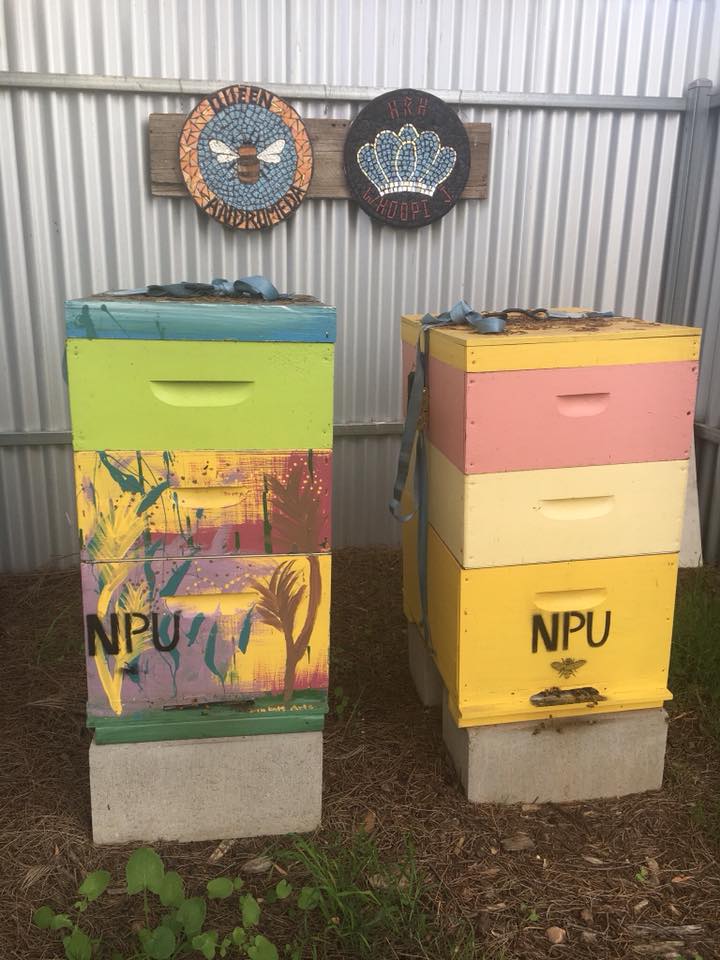 We work in close partnership with Adelaide Bee Sanctuary to support urban honey beehives in selected community open spaces. These beehives are secured behind locked enclosures, are professionally managed by Adelaide Bee Sanctuary and house the Golden Italian bee, known for their gentleness.
You are welcome to visit them and watch them go about their busy daily lives!
Hives are located at:
- Athelstone Community Garden
Padulesi Park, 3 Victoria Avenue, Athelstone - Campbelltown Community Orchard
behind Reservoir Road Reserve and playground, Paradise
For additional information on supporting urban bees, visit:
The native bees that live in South Australia are solitary and do not live in hives or produce honey. They do however play an important part in the pollination of Australian native and other plants.
Council is home to two native bee hotels:
- Campbelltown Bee BnB at Lochiel Park Butterfly Garden
The Campbelltown Bee BnB was constructed with 60 community members in July 2018. - Thorndon Park Native Bee Hotel
The Thorndon Park native bee hotel was constructed as a part of the playground redevelopment in 2022.
For additional information about supporting native bees, visit: