

Partnerships for biodiversity conservation
We are proud to partner with local community members, groups and organisations to protect and grow the biodiversity of our city.
Have you spotted our biodiversity activity in local parks and waterways? Perhaps you’ve seen one of our planting events, teams of volunteers mulching garden beds, or even birds and animals using our water stations? We’d love to hear your thoughts and what you see in our new habitat features! Please share your feedback with customer service at 08 8366 9222 or mail@campbelltown.sa.gov.au
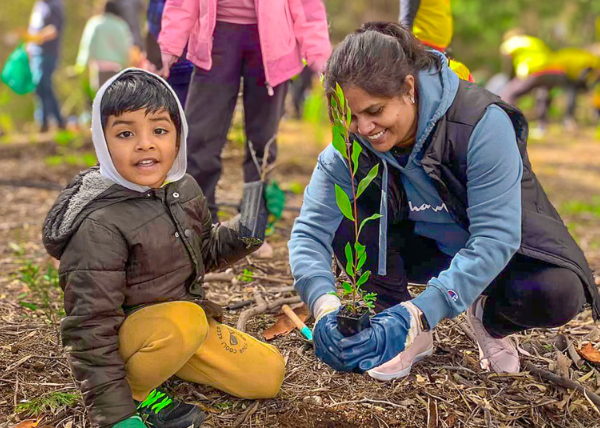
We’re partnering with Conservation Volunteers Australia (CVA) to rewild Fifth Creek. Our community is invited to join as part of a three-year nature-based revegetation and management project designed to enhance the ecological health and water quality of Fifth Creek.
Running until 2028, the project focuses on:
- improving water quality downstream
- restoring habitat connections
- enhancing riparian areas and
- increasing community access to nature.
The project area spans the Fifth Creek corridor, linking the Adelaide Hills to the River Torrens/Karrawirra Pari.
This initiative will create long-term environmental benefits, including improved water filtration, erosion control, and greater habitat availability for native species such as the Yellow-tailed Black-Cockatoo, Grey-headed Flying Fox, and Superb Fairy-wren. Additionally, the project will contribute to reducing urban heat effects, increasing shading, and strengthening the resilience of the local ecosystem.
Over the next three years, the project will include:
- woody weed removal, targeting non-native trees and shrubs that threaten native biodiversity
- planting 2,450 riparian plants and 7,900 floodplain plants to restore habitat and stabilise creek banks
- habitat restoration, including the creation of nesting sites and shelter for birds, arboreal mammals, and aquatic species
- Community engagement, with opportunities for volunteering, educational activities, and hands-on conservation efforts.
The 2026 planting season is completed. There will be activities over summer. To get involved, sign up to the project via the button below.
Learn more about the Rewilding Fifth Creek Project
This project is funded by the Australian Government’s Natural Heritage Trust under the Urban Rivers and Catchments Program.
If you would like more information, please contact Jacqui Wilson of Conservation Volunteers Australia (CVA) on 0488 295 521 or jwilson@cva.org.au.
Frequently asked questions
What are ‘woody weeds’?
Woody weeds are non-native trees and shrubs that invade natural areas, spreading aggressively to outcompeting native plants and disrupting ecosystems. Common woody weeds in the project area that are highly invasive or are declared weeds include Wild Olive, Desert Ash (Fraxinus angustifolia), Swamp She-oak (Casuarina glauca), and Golden-wreath Wattle (Acacia saligna).
Why are woody weeds being removed?
Woody weeds negatively impact native biodiversity by competing for sunlight, nutrients, and water. They also drop large amounts of leaves and seeds, further preventing native plants from growing. Their removal will create space for native species to establish, improving habitat quality for local wildlife.
Will the project impact local wildlife?
The project is designed to enhance wildlife habitat by replacing woody weeds with native species that provide better food and shelter for birds, mammals, and aquatic species.
In the short term, the removal of trees means some birds may be displaced, but the establishment of trees and other vegetation that suit the area will bring the wildlife back.
How will the removed woody weeds be used to support wildlife?
Instead of removing all woody weeds from the site, some will be repurposed to create wildlife habitats. This includes:
- Creating habitat features such as nest boxes and perches for birds and tree-living mammals.
- Leaving some deadwood in place to provide shelter and food sources for insects, reptiles, and small mammals.
This approach ensures that while invasive species are removed, they still contribute positively to the ecosystem.
How will this project impact the Yellow-tailed Black-Cockatoo?
The project will benefit Yellow-tailed Black-Cockatoos by providing more native trees and shrubs that supply their natural food, like sheoaks, eucalypts, and banksias. The new plantings will also help create better long-term habitat for them to live and nest in. Since birds can move freely, they will find other habitats and food sources in the meantime.
We’re partnering with Conservation Volunteers Australia (CVA) to deliver the Urban Shade Forest project. Our community is invited to help create cooler, greener suburbs through tree planting and nature-based restoration over a three-year period.
Urban heat refers to elevated temperatures in built-up areas caused by heat-retaining surfaces, and the Urban Shade Forest project helps combat this by increasing tree cover to provide more shade.
Running until 2027, the project focuses on:
- increasing tree canopy cover
- reducing urban heat
- restoring native habitat and biodiversity
- building climate resilience in residential areas
Targeted project areas include council-managed land at River Drive Reserve, Athelstone Recreation Reserve, Tom Packer Drive, The Dress Circle Park Area and Thorndon Park.
This initiative will deliver long-term environmental and social benefits, including cooler spaces, improved air quality, and enhanced wildlife habitat. Additionally, the project will foster greater community wellbeing through access to green spaces.
Over the next three years, the project will include:
- planting 7,000 native plants each year to grow our urban forests
- creating connected habitat corridors to support birds, insects, and small mammals
- community engagement, with opportunities for volunteering, educational activities, and hands-on conservation efforts.
The 2026 planting season is completed, please check in April 2027 for upcoming events.
Learn more about the Urban Shade Forests Project
The Urban Shade Forest project is funded by Chevron through CVA.
If you would like more information, please contact Teresa Gustowski of Conservation Volunteers Australia (CVA) on 0475 965 817 or tgustowski@cva.org.au.
 The Campbelltown Landcare Group was established in 1994 to work in partnership with Council to protect areas of indigenous vegetation within Campbelltown Council reserves. Since it's inception, the group has made a valuable contribution to the management of biodiversity in a number of Council reserves.
Through a partnership with Council, Campbelltown Landcare now concentrate all of their efforts on working to restore the indigenous vegetation and habitat values of Wadmore Park - Pulyonna Wirra. Wadmore Park - Pulyonna Wirra is the best example of biodiversity within the City.
Campbelltown Landcare have successfully attracted State Government funding for projects that benefit Wadmore Park - Pulyonna Wirra and the Council area, including:
- re-aligning natural flow lines of 5th creek to help prevent further erosion within Wadmore Park - Pulyonna Wirra
- surveying the flora of Wadmore Park - Pulyonna Wirra to enable a Vegetation Management Action Plan to be developed
- re-vegetating parts of the park including the riparian zone of Fifth Creek with local indigenous plant species
- undertaking weed management within the park to allow local species to re-establish
- producing promotional materials about the work of Landcare in the local community
For more information about the group check out their Facebook Page, email campbelltown.landcare@gmail.com or 0412 020 140.
 The Gums Landcare Group was established in 2016 and focuses on improving the biodiversity in and around the Gums reserve along Third Creek. Works have included planting and weed control, signage with working bees and various training and information sessions provided to members who volunteer their time frequently.
The Gums Landcare Group has also worked with Council on remediation in the creek channel, the Adopt a Spot litter removal program, and engaged in flood prevention and erosion prevention activities.
The group undertakes regular events, working bees and hosts an event in the Nature Festival during the October School holidays.
For more details please visit their Facebook Page or contact Chairman Gerry Butler on 0407 972 149 or email gerry.landcare@iinet.net.au
Green Adelaide supports communities, schools and Councils to protect our remaining remnant vegetation by providing:
- programs for revegetation of local indigenous plant species
- funding assistance for projects that enhance biodiversity
- technical advice regarding biodiversity conservation
- promotional materials and educational resources
While urban areas are dominated by people, and our roads and buildings, there is still significant biodiversity to be found within our cities and suburbs. Many of these species are under significant pressure from ongoing development but there is a lot we can do to assist in providing resources to support their ongoing survival.
For more information and downloadable resources visit their website.
The Friends of Lochiel Park community group was formed by local residents to help create and maintain a healthy, biologically diverse and attractive public space within and around the Lochiel Park development.
In partnership with Council, the Friends of Lochiel Park contribute to projects that include planting and caring for native vegetation, supporting habitat for local wildlife and advocating for improvements to public spaces.
The group invites the local community to get involved and learn more about the importance of biodiversity and sustainable environmental management.
For more information, visit friends.lochielparkcommunity.com.au, email folp5074@gmail.com or contact President Willie Smyth on 08 7220 7418.
Friends of Black Hill and Morialta have been protecting and restoring the native vegetation, biodiversity and cultural heritage of Black Hill, Morialta and Horsnell Gully Conservation Parks for the last 40 years.
Working in partnership with National Parks and Wildlife Service South Australia, local councils and the broader community, they protect habitat through restoration programs and engage with the community by providing fun and informative experiences.
They are always welcoming new members and volunteers to join them in the wide variety of activities on offer, including restoration actions, research projects, fundraising initiatives and educational events.
For more information about the group and their events, visit the Friends of Black Hill and Morialta Facebook page, visit fobhm.org.au, email secretary.fobhm@gmail.com or call Acting President John Fleming on 0418 495 834.