

Penfolds Winery
One of the greatest success stories of the early pioneers in South Australia is that of Penfolds Winery at Magill. Dr Christopher Rawson Penfold is the person to whom we attribute the founding and growth of this South Australian icon. It appears that his wife and her maid may have had a more substantial input than the doctor himself.
Christopher Rawson Penfold was born on 2 August 1811 at Steyning, Sussex, in England. His father was John Penfold, the vicar of Steyning, and his mother Charlotte Jane Penfold (nee Brooks). Christopher studied medicine at St Bartholomew’s in London. On 26 May 1835, he married Mary Holt, only daughter of Thomas Holt, a medical practitioner of Edmonton, London.1 Christopher was 24, and Mary was 15 at this time.2
In 1838, the Penfolds decided to move to Brighton to begin practice in medicine. Brighton was the place to be for English society. George, the Prince Regent, later to be George IV, had built his home, the Brighton Pavilion. The prices of property in Brighton rose dramatically as everyone wanted to live there. So you can imagine the cost of a property big enough not only to live in, but to accommodate a surgery and waiting room too. Christopher had to borrow heavily to obtain this property. He borrowed the money from his older brother Tom. What happened next is uncertain, but the outcome was that Tom did not receive the interest he was due on the sale of the property. This caused a family dispute, and Christopher and Mary were assisted financially by the family to immigrate to South Australia.3 Christopher had an interest in wine, and like many medical men at that time, believed wine could be a medicinal help in cases of anaemia. Before setting out for South Australia, he collected vine plantings from the Rhone area in France.
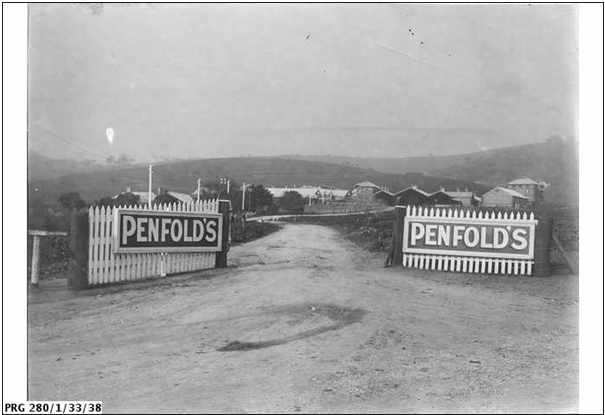
The entrance to Penfolds winery (State Library of South Australia PRG 280/1/33/38.)
In 1844, the Penfold family, with daughter Georgina, arrived in South Australia aboard the Taglioni. Also on board was Mary Penfold’s domestic servant Ellen Timbrell. Prior to leaving England, the Penfolds had paid a deposit to the Colonial Land and Immigration Commission. This enabled them on arrival to purchase 500 acres of land at Makgill, now Magill. The land was purchased for £ 1,200 from Edmund Trimmer and formerly belonged to Robert Cook and William Ferguson. There was a small cottage on the land built by William Ferguson. The Penfolds increased the size of the cottage and called it The Grange.4 At the time of purchase, 200 acres were producing grain.5 This grain production, along with Christopher’s income from his practice, was able to sustain the family, whilst the vine cuttings he had brought from France were growing and maturing.
As a medical practitioner, he was required to conduct post-mortems, attend inquests, and assess the health of persons suspected of having a mental illness. He was also the 1st chairman of the Burnside Council. This kept him very busy, so the farm and the vines were tended by Mary Penfold and Ellen Timbrell. Christopher became ill and died on 26 March 1870 and was buried at St George Church, Woodforde, where he was a member of the vestry.
By 1871, just a year after Christopher’s death, the stock on hand at the winery was 107,000 gallons (486,432 litres), one-eighth of the total wine production in South Australia. In the early days, Port and Sherry were the main production, but now Claret and Riesling had gained acceptable sales too. The two women had been running the property most of the time before Christopher’s death. They continued running it, so not a lot changed; it was still very successful. By this time, their daughter Georgina had married Thomas Francis Hyland. He was a public servant in Victoria, where they both lived.
By 1881, the amount of wine produced at Penfolds, was one third of South Australia’s total wine production.6 Penfolds had built up a profitable export trade with New Zealand. Trade between the Australian colonies was restricted by high excise tariffs. The way they overcame this was to open their own winery in Victoria in the 1880s and in NSW in the early 1900s.
By 1911, they had also expanded into McLaren Vale and Nuriootpa in South Australia.7 Georgina and her husband became responsible for wineries in the other colonies. Mary Penfold died on 31 December 1895, and she was buried next to Christopher in St George Church, Woodforde. The business passed on to Georgina Hyland, who later changed her family name to Penfold-Hyland.
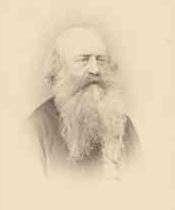
Christopher Rawson Penfold taken in 1869 (B22969 State Library of South Australia)
In 1943, Penfolds acquired the Auldana winery next door to them at Magill. Their flagship was the award-winning St Henri claret. In 1956, John Davoren, the winemaker at Auldana cellars created the very successful unwooded light claret using the St Henri name. Meanwhile, in 1950, at Penfolds, winemaker Max Schubert went to France to find out how to make a wine that would keep for 20 years. 1951 was the vintage of the first Penfolds Grange Hermitage. It was never commercially released, as Max was sure it could be better. In 1953, Grange Hermitage was made from Cabernet as well as Shiraz grapes. Due to the inconsistent quality of the Cabernet grapes, it was never made again. This vintage, because it was a 'one of' is now a very rare and sought-after wine. In 1957, Max took a sample of his Grange Hermitage to the Penfolds Board in Sydney for them to taste. They were not impressed with it. He was asked not to spend any more time and money on the project. Although totally shattered, Max continued to make his Grange Hermitage and had to resort to hiding each vintage from the board. To this day, you can see the hiding places at the Magill Estate, where Max hid his Grange Hermitage.8 Although Grange Hermitage was never again made from Cabernet Sauvignon grapes, a collector's wine was produced using these grapes from a single vineyard. It is known as 2004 Block 42. Only twelve bottles were made, and they sold for US $168,000.00 per bottle.9
There is talk in the wine industry of the 'Penfolds Curse'. They believe it is brought about by the business being taken out of a family concern to a Corporation Status. In the 1980s, Tooth and Co (part of Adelaide Steamship Co) purchased a number of wineries, including Penfolds. Adsteam then sold its wineries to SA Brewing Co. When SA Brewing split into three separate entities, the wineries became Southcorp Wines. In 2005, Southcorp Wines sold to the Fosters Group. In 2011, the wineries in the Fosters Group separated into a publicly listed company on the stock exchange, as Treasury Wine Estates. Even today, there is talk of a takeover of Treasury Wines.
If there is a family curse, you would have to think it is brought about by Mary Penfold, with help from Helen Timbrell. You can understand their displeasure when you consider what they put into Penfolds in those early years.
State Library of South Australia, SLSA: B 22969
Researched and compiled by Jim Nelson, a volunteer with the Campbelltown Library 'Digital Diggers' group.
References
- D. I. McDonald, 'Penfold, Christopher Rawson (1811–1870)', Australian Dictionary of Biography, National Centre of Biography, Australian National University, http://adb.anu.edu.au/biography/penfold-christopher-rawson-4387/text7143, published first in hard copy 1974, accessed online 10 February 2016
- 'Mary Penfold (1820-1896) South Australian Wine Grower', Australian Women's History Forum https://awhf.wordpress.com/2010/03/02/mary-penfold/ first published 2 March 2010, and accessed 10 February 2016
- Jane Resture, Great Australian Women, http://www.janesoceania.com/australia_great_women_marypenfold/index.htm (no longer available), accessed 10 February 2016
- 'Penfold cottage or "The Grange", Houses in Magill, http://www.steveswann.net/magill/1900/Penfold.html (no longer available), accessed 10 February 2016.
- D. I. McDonald, 'Penfold, Christopher Rawson (1811–1870)', Australian Dictionary of Biography, National Centre of Biography, Australian National University, http://adb.anu.edu.au/biography/penfold-christopher-rawson-4387/text7143, published first in hard copy 1974, accessed online 10 February 2016
- Anne Burrows, ‘Penfolds’, SA History Hub, History SA, https://sahistoryhub.history.sa.gov.au/organisations/penfolds, accessed 10 February 2016.
- Anne Burrows, ‘Penfolds’, SA History Hub, History SA, https://sahistoryhub.history.sa.gov.au/organisations/penfolds, accessed 10 February 2016.
- Jesus Diaz, 'The Strangest, Most Expensive Wine Bottle In The World Is Australian', Gizmodo, https://gizmodo.com/the-strangest-wine-bottle-in-the-world-is-also-the-most-5922163, accessed 10 February 2016