

Paradise Bridge Hotel
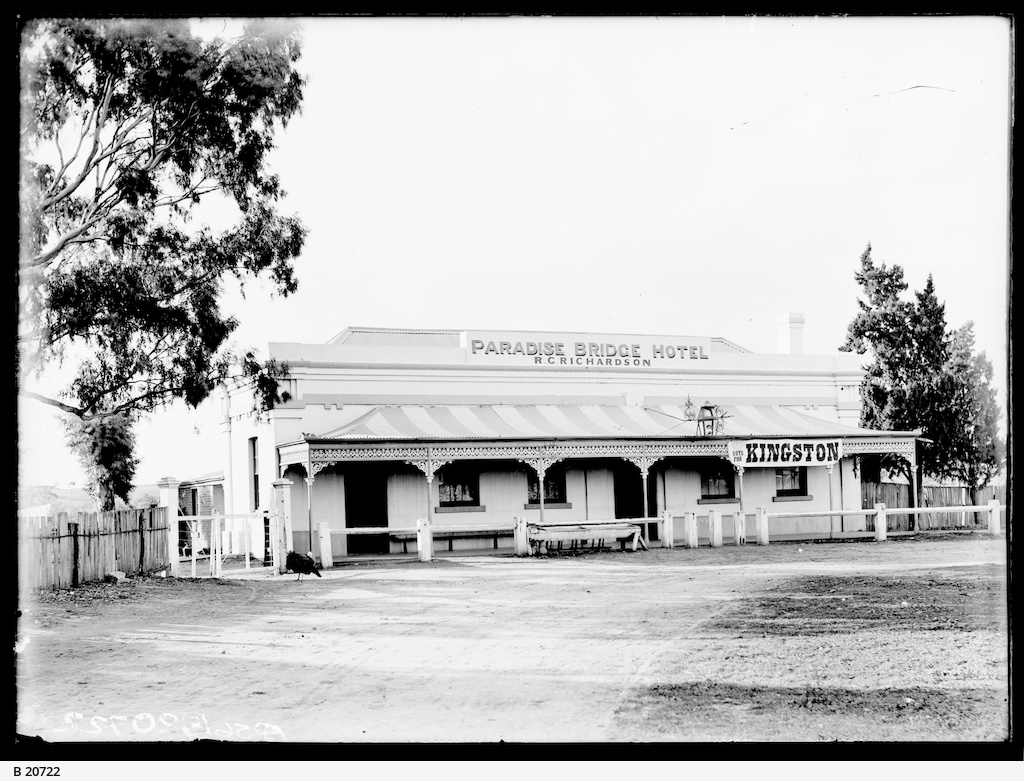
Early records reveal that Paradise was simply referred to as “on the Torrens”. It was later named “Shepley” by Alfred Hardy, a brother of Arthur Hardy, MP, their father having been the Lord of the Manor of Shepley in Yorkshire. Alfred owned a section of the land along the Torrens, where today the Paradise Bridge crosses the river.
The suburb of Paradise, originally named Shepley, was renamed by Joseph Ind, who had arrived in South Australia on 4 December 1837 with his wife Mary and children George Frederick and baby daughter Harriet. Joseph was born in Tetbury in the Cotswolds of Gloucester in England.1
Paradise was crowded, but managed to sustain small dairy and poultry farms. Some streets in the Paradise area still perpetuate the names of the original local residents, e.g. Robertson, Ramsey and Philpot. Irish families also settled in Paradise, including Jabez Jury of the Hectorville family and the midwife, Mrs Mountstephen.2
Joseph Ind was one of the early settlers, originally living in Hindley Street, Adelaide, for a short time before acquiring his land. In 1840, land was cleared on Darley Road to grow melons and vegetables, and a small cottage close to the Lower North East Road was also built. Owing to its proximity to the River Torrens, there were 33 acres of fertile river flat.3
In 1842, at Adelaide’s first Agricultural Exhibition, Ind won prizes for best barley, best watermelons and the best collection of culinary vegetables.
Being an astute businessman, on 11 December, 1850, Joseph added a room to the front of his cottage at Paradise and applied for a licence to establish a “bar” selling wines, spirits and ales from this room. This cottage was located on land abutting the present bus loop off the Paradise Main Road, where subsequently the late Matthew Packer, a past member of the Council, built a fine modern home. James Crowle, who still had a hotel in Darley Road, and many residents protested the establishment of another hotel.
However, their protests proved fruitless, and Joseph subsequently erected the new hotel and called it “The Paradise Bridge Hotel”. He derived the name from a property called Paradise near his home of Tetbury in England. The new hotel was advertised with a banner flying in front of his hotel inscribed “Come to the Paradise Inn”. Joseph was known for the quality of the water and sweet melons he grew, which explained the inscription displayed in the public bar of the hotel, which read “Who’d thought it, melons bought it”. Evidently the growing of melons at that time was a very profitable undertaking owing to the scarcity of other fruits.
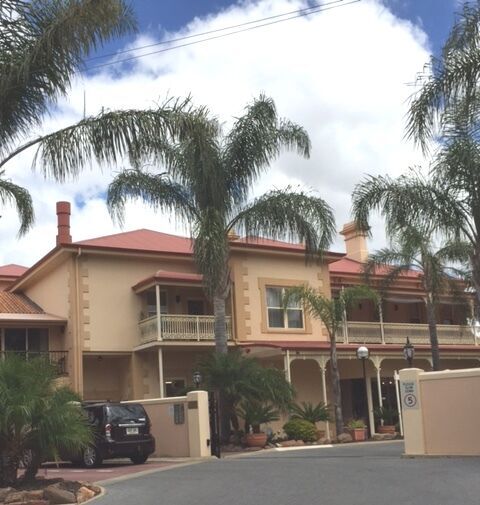
Balmoral House, photo taken in 2015
In the 1850s, while still the licensee of the Paradise Bridge Hotel, “Ind acquired allotments 10 to 20 of the township of Balmoral and on allotment 19 began to build Balmoral House.” This house was built from the “cellar up” with the Ind family moving in once the cellar was complete and construction of the ground floor was underway, Balmoral Road was the original entrance to the property, which is today a retirement village. Joseph’s descendant Christopher Ind and his mother sold the house and moved to Sydney with the balance of the family. At the time of the sale, the property was completely unrestored and still in excellent condition, containing original furnishings, including horse stables, a croquet lawn and rare trees which had been brought from around the world. The family names are still found in streets in the area, e.g. Ind and Christopher. In 1856 Joseph’s first wife, Mary, died at Balmoral House “after having taken a cold draught of water from the Torrens”. His mother also died at Balmoral in the same year.4
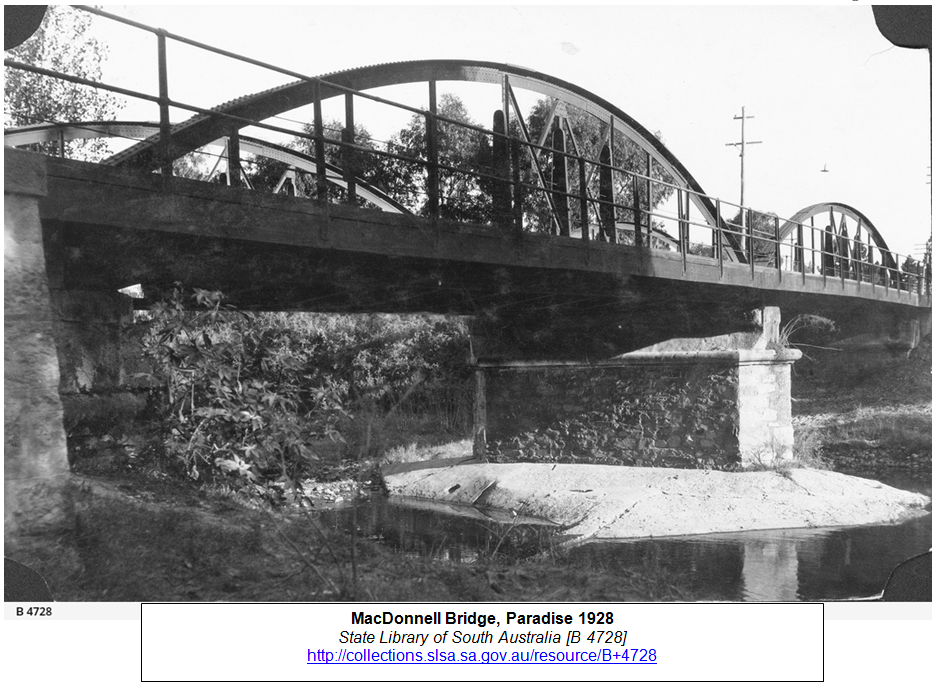
In 1857 the original Paradise Bridge, then known as the MacDonnell Bridge, over the River Torrens, was opened. Consequently, this brought easier access and more prosperity to Ind’s hotel. Not only did James Crowle protest the creation of the hotel itself, but he also, along with other interested parties, objected to the location of the bridge, realising the advantages it would bring to Joseph Ind’s various business interests.
In May 1865, aged 56, Joseph Ind was killed accidentally “by the upsetting of a dray while returning homewards from town”. An inquest into his death showed he was asleep while driving the cart.5
For five years after Joseph Ind’s death, his widowed second wife, Mary (née Roberts), who was active in the business preceding his death, took over the running of the Paradise Hotel. “Earlier she had worked in her first husband’s Hindley Street grocery, so that the business world was not new to her”. After her retirement in 1871 and the estate wound up, it seems that she found herself without a purposeful life and regretted ever giving up the business. Mary, it was noted by G.F. Ind at the enquiry into her suicide that she had felt “lonely and useless as a lady of leisure”. “Harriet Wettenhall, married woman, step-daughter of the deceased, said Mrs Ind often spoke despondingly, complaining of loneliness etc. Once she took witness’s hand and shook her saying “Oh, how you would pity me if you know how I feel. God forgives me, I feel as if I should go out of my mind, for when I am lying in bed and hearing the river roaring it makes me melancholy, and I dare not go down by it, the temptation is too great”. Mary made the decision to take her own life in the river. “James Beasley, gardener, said that on being informed by Frederick Roberts that Mrs Ind was in the river, he found the body in the middle of a waterhole. Undressed, went and brought the body to land. It was floating face upward. Had been acquainted with the deceased for many years. She seemed in very low spirits for some time past”.6
Other members of the Ind family arrived from England in the mid-1800s and added two more homes of significance in the area. The first being the base building for the existing retirement home opposite today’s Paradise Hotel on the Lower North East Road. The final and currently still original Ind related residence (Lyndhurst) can be found at Urban Avenue, Paradise. Its tessellated tile chimneys can be seen from the Lower North East Road. There are many minor dwellings also found on this road and in the vicinity of Balmoral House that were built as shearers’ quarters.7
Joseph’s son, George Frederick, became a member and chairman of the District Council, and served in these offices for many years. He was a prominent gardener who was the unfortunate victim of a holdup by a bushranger near the Glynde Corner. This prompted other market gardeners from that time on to take the precautionary measure of hiding their day’s takings in sacks and boxes on their return journey home from the market.12 September 1906.8
In most of the oral histories of the area, the hotel is remembered as the Temperance Hotel. The following is a quote from an interview with Barbara Cooke, a participant in the Campbelltown Oral History Project. The date of her recollection is unsure, but it probably refers to activity in the early 1940s. “And, as I said, it was known as the ‘Bridge Hotel’. The hotel wasn’t open, but you could go behind the back door, and Mrs Fox, she’d sell you sweets from there, so I gather she lived at the hotel actually, but I don’t know what [happened]. I don’t know. Not many people know it as the ‘Temperance Hotel’, but I can always remember it having ‘Temperance’ written on there. But, as I say, on the quilt we’ve done it and it’s got the ‘Bridge Hotel’.”
After the Ind family, several different people managed or owned the hotel up until it was demolished in 1959 and listed below are subsequent licensees:9
- 1850 Joseph Ind
- 1856 Thomas Williams
- 1861 Joseph Ind
- 1865 Mrs Joseph Ind
- 1871 R. Aveling
- 1873 G. F. Ind
- 1879 sub-let to James Bryant
- 1896 Richard Aughey
- 1900 Robt. G Richardson
- 1903 Arthur Delmont
- 1906 sold to Thomas O'Mara of East Torrens Hotel, Magill
- 1907 D. George, landlord
- 1909 Temperance Hotel – licensee Mrs Waite – Thomas O’Mara proprietor
- 1959 Demolished; replaced by Matthew Packer's house, 707 Lower North East Road
The implementation of the Local Option Act governing licensed premises was brought into effect in 1905. The aim of the act was to greatly reduce the number of hotels in the East Torrens local option district by up to one third. The Special Bench (Messrs. J. Gordon, S.M., G.F. Claridge and A. McDonald, M.P.) appointed to take evidence sat for that purpose at the Adelaide Police Court on 24 February 1909. Evidence was tendered on behalf of the hotels.
Unfortunately, complying with the new regulations resulted in hardship for the licensee of the Paradise Bridge Temperance Hotel, Mrs Anna Waite. Mr Wadey, in asking for a first class certificate for Mrs Waite, pointed out that “had she been able to dispose of her license before the Act came into force, she would not have been reduced to a state of insolvency. Prior to this application for a licence, Mrs Waite had conducted her business to the complete satisfaction of the authorities, and a first class certificate was awarded with the court acknowledging the extreme hardship of this case. “Licensees had in the first instance been required to make improvements by the Licensing Bench, and in many instances had done so. But when the Special Bench took up its work the licensees found that the money had been virtually thrown away as their licenses were not renewed. The outcome was that their property was robbed of value and they themselves reduced to a condition of pecuniary difficulty.”10
Mr J. R. Anderson appeared for the licensee, Mrs Waite. The licensee said there were 11 rooms in the house, two of which were available for lodgers. She had three regular boarders. Her house was much frequented by market gardeners and other travellers, and for their benefit she had had one room fitted up for their use, and another made available for occupation by persons waiting for trams. A large paddock in front of the house was much used by teamsters. The Glynde was the nearest hotel. Thomas O’Mara, proprietor of the Paradise Bridge Hotel, said he was prepared to spend from £1,200 to £1,400 in making improvements and additions to the hotel if the license was renewed. He had spent about £300 on it during the past two years and was now erecting a weigh bridge. Another witness testified to the quiet, orderly way in which the hotel was kept. He and other witnesses called said they considered the requirements of the locality demanded the continuance of the hotel.11
There are records of a 1930 meeting of Market Gardeners and a 1921 meeting of the Torrens Valley Agricultural and Horticultural Society.
No further records of the premises operating as a hotel are available on “Trove” after 1930, and the eventual demolition of the premises occurred in 1959.
References
- From Settlement to city: a History of the District of Tea Tree Gully 1836-1976.Viewed 21 January 2016.
- Section 355 Newenham, Paradise, Lyndhurst. Folder Local History Room, Campbelltown Public Library, SA. Viewed 21 January 2016.
- From Settlement to city: a History of the District of Tea Tree Gully 1836-1976. Viewed 21 January 2016.
- Ind Paradise Folder, Local History Room, Campbelltown Public Library, SA. Viewed 21 January 2016.
- Ind Paradise Folder, Local History Room, Campbelltown Public Library, SA. Viewed 21 January, 2016.
- 1871 ‘Coroner’s Inquest’. The Express and Telegraph (Adelaide, SA: 1867—1922), 26 October, p. 3, edition: second edition. Viewed 21 January, 2016, http://nla.gov.au/nla.news-article207700286.
- Paradise, SA. Wikipedia. Viewed 21 January, 2016. https://en.wikipedia.org/wiki/Paradise,_South_Australia.
- Campbelltown 1869-1968. Viewed 21 January 2016. Leaney, John T. (1968). Published by The Corporation of the City of Campbelltown.
- Ind Paradise Folder, Local History Room, Campbelltown Public Library, SA. Viewed 21 January 2016
- 1909 “Closing of an Hotel”, The Express and Telegraph (Adelaide, SA:1867-1922), 27 July, p.1 edition: 4 o’clock., viewed 21 January, 2016, http://nla.gov.au/nla.news-article209669925.
- 1909 “Local Option”, The Advertiser (Adelaide, SA:1889-1931), 24 February, p. 10, viewed 21 January 2016, http://nla.gov.au/nla.news-article5176154.
Photo references
- Paradise Bridge Hotel. [B 20722] State Library of South Australia, Viewed 21 January 2016. http://collections.slsa.sa.gov.au/resource/B+20722
- Balmoral House. Private photo taken January 21, 2016.
- MacDonnell Bridge, State Library SA, Paradise collection, viewed 21 January 2016.
- Lyndhurst. Viewed January 21, 2016. https://www.google.com.au/maps/