

Langton Park
Today, Langton Park is a beautiful retirement village of over a hundred separate units; ideally located and a sought-after address. The original homestead is still in use as the village hub and recreation area. In 1919, when the property was advertised for sale, it was described as a massive stone residence of eight rooms. It had extensive outbuildings with a picturesque garden, vineyard and orchard on 14 acres of ground.1 The name of the house was 'Oamaru'. This is a Maori word meaning 'the place of Maru'.
The house was built in 1891 by Robert Bradshaw Olliver Todman. He was known as 'Toddy' to his close friends. He was a well-known trader in the Adelaide Stock Exchange and was a partner in Todman and Barnett, who operated out of Selborne Chambers in Pirie Street. 'Toddy' Todman was born at Magill on 24 May 1862. His parents were James Todman MD and Cecelia Todman (nee Olliver), who at one time lived at 'Cosford', which is just across Montacute Road, and is still inhabited to this day. James Todman MD came to South Australia in 1852. He studied medicine in Edinburgh and at Adelaide University. James Todman had a brother who intended to immigrate to New Zealand. He bought a large portion of land from the New Zealand Company in London in 1840. He died before he got to immigrate. The land was bequeathed to his nephew, R.B.O. Todman, in Adelaide. A.B. Fitchett, who owned a neighbouring property in New Zealand, bought the land from R.B.O. Todman and subdivided both lots into 245 building blocks in the Wellington suburb he called Fitchett. Two of the streets in this subdivision were named Todman Street, after R.B.O. Todman and Charlotte Avenue, after his sister Charlotte Todman.2 R.B.O. Todman was educated at St Peters. He was very keen on sport. He was often seen at the horse racing either in Adelaide or at Flemington.3 When a new bowling club opened in Adelaide, 'Toddy' was among the early players.4 He was well loved by his friends for his sense of humour. Whilst holidaying at American River on Kangaroo Island with a friend, Mr Ryeberg. When asking for another piece of fried fish, he addressed his host as Mr Fryberg. He was politely told the correct name was Ryeberg. He then requested some water from Mr Dryberg. Again, he was politely told the correct name was Ryeberg. Everyone was in stitches, and for the rest of the evening, he called the host anything but his correct name. All who were there remembered this for many years after.5 'Toddy' never married, he remained a bachelor until he died on 5 August 1914, aged 51 years. In the latter years of his life, he did not live alone in that large house. After the death of her husband, his sister, and her two children, shared the house with him.
Charlotte Mary Bradshaw De Burgh married John William Dudley De Burgh on 20 July 1893 at St George Anglican church at Woodforde.6 St George was the first church consecrated in the colony of South Australia.7 John William Dudley De Burgh was the eldest son of Captain W.T. De Burgh, who was influential in the formation of the Militia in South Australia. William De Burgh was a public servant in the Crown Lands Department in Adelaide. In 1899, he volunteered to serve in the Boer War.8 He died in Bombay on 16 April 1906, aged 39 years.9 He left a wife, a son and a daughter.
His son was Persse William Todman De Burgh. On 15 November 1915, Persse signed up as a private in the 5th Machine Gun Battalion. He left Australia on 1 May 1916 and served in France. He returned to Australia on 18 August 1919 and was discharged on 2 October that same year.10 Mrs Charlotte De Burgh meantime was still living at 'Oamaru' with her daughter. She was the first person in South Australia, in 1915, to offer her home as a Hospital for Servicemen. It was to be called 'De Burgh Voluntary Aid Home.'
His daughter was Constance De Burgh. She married Reginald Henry Mowat, who had studied at Roseworthy College, gaining a second class diploma with honours in agriculture and viticulture. They became engaged in 1922 at Great Western in Victoria11, where he had been sent by Seppelt and Co, his then employer. He later worked for Leo Buring. When they listed on the stock exchange in Melbourne in 1941, he became a director.12 He later became General Manager of Leo Buring, and with his wife moved to Sydney.
In 1919, Mrs De Burgh decided to move to Brighton in Victoria. She remarried and became Mrs McSweeney. The house and land was sold to Mr and Mrs Whitlock Jones. She died on 16 May 1944 at her home in Seymour Grove, Brighton Beach Victoria.
During the Second World War, the house was now called 'Dura', and again it was a place of sorrow. Mr and Mrs Whitlock-Jones had three sons in the forces. Pilot officer William Hesketh Jones who flew Wirraway A20-14’s was killed on 29 December 1941, aged 22 years, in a training accident in Victoria.13 He is buried in Nailsworth Cemetery. Brothers Peter Hesketh Whitlock Jones, Lieutenant in the 2nd/43rd AIF, and David Whitlock Hesketh Jones, Flight Lieutenant, both returned from the war. The Whitlock-Jones family raised funds for St Martin’s Church of England on Gorge Road. They also raised funds for St Georges Church at Woodforde. They held fetes and garden parties at their home to raise the money.14 They spent their time between 'Dura' and their farm at Cummins. Mr Whitlock-Jones exported horses, mainly to the Indian army, and he would often travel to India with them.
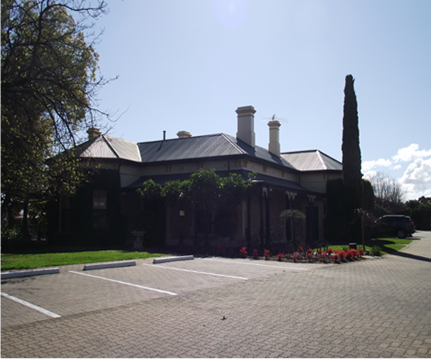
In 1990, the property was developed as 'Langton Park'. On the acreage surrounding the home, 110 units were constructed, offering independent retirement living.
References
- The Register (Adelaide, SA : 1901 - 1929) Friday 14 March 1919 p 6
- http://www.wcl.govt.nz/wellington/streetspart3chap3.html
- The Advertiser (Adelaide, SA : 1889 - 1931) Wednesday 8 March 1899 p 7
- The Advertiser (Adelaide, SA : 1889 - 1931) Monday 20 June 1898 p 6
- Chronicle (Adelaide, SA : 1895 - 1954) Thursday 28 January 1932 p 2
- South Australian Register (Adelaide, SA : 1839 - 1900) Wednesday 2 August 1893 p 4
- https://magillanglican.wordpress.com/activities/historical-group/
- South Australian Register (Adelaide, SA : 1839 - 1900) Friday 22 December 1899 p 5
- Observer (Adelaide, SA : 1905 - 1931) Saturday 28 April 1906 p 29
- https://www.aif.adfa.edu.au/showPerson?pid=75865
- The Mail (Adelaide, SA : 1912 - 1954) Saturday 1 July 1922 p 15
- The Argus (Melbourne, Vic. : 1848 - 1957) Tuesday 24 June 1941 p 2
- Burra Record (SA : 1878 - 1954) Tuesday 13 January 1942 p 3
- The Advertiser (Adelaide, SA : 1931 - 1954) Thursday 29 November 1951 p 8