

Pinkerton, Rachel
Athelstone
William Pinkerton and Eleanor Smith were married at Ford, Northumberland, England, on 23 January 1838. Shortly after the wedding, they embarked on a new life in the emerging colony of South Australia. The couple sailed from England on 20 July 1838 aboard the Rajasthan, arriving in South Australia on 15 November 1838 (Passengers in History, n.d.).
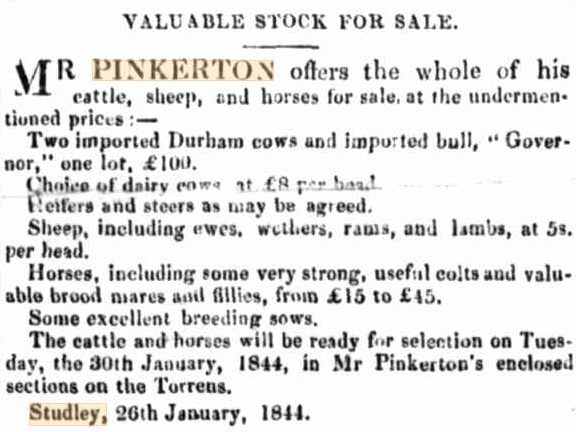
They brought with them substantial supplies to establish their home, including clothing, furnishings, farming equipment and livestock (Reynolds, 1929). Settling near the junction of Sixth Creek and the River Torrens, they established a farm which they named 'Studley' (South Australian Register, 1893).
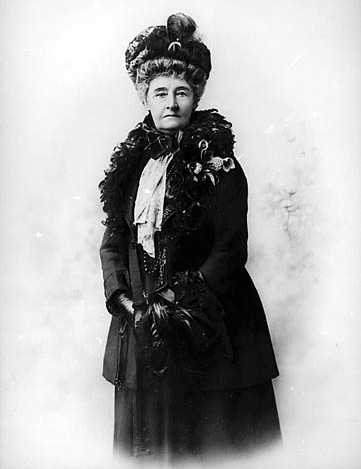
On 19 December 1838, their daughter, Rachel Selina Pinkerton, was born at 'Studley' (now Athelstone). Rachel later believed she was the third child born to newly arrived settlers in South Australia (Reynolds, 1929). When Rachel was just 36 hours old, the family home was destroyed by fire. Most of the household’s belongings were lost, including a piano, a harp, ten years' supply of clothing brought from England and the baby's delicately hand-sewn layette (Reynolds, 1929).
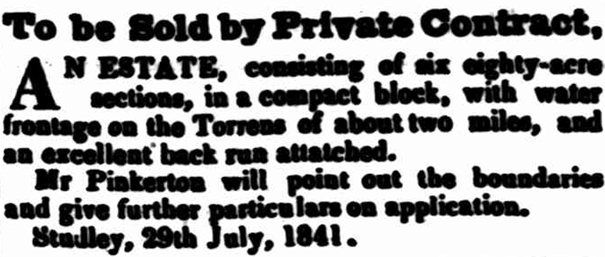
Life in the new colony proved challenging. In 1841, William Pinkerton unsuccessfully offered the property for sale, reflecting the significant challenges faced by early settlers in South Australia (Southern Australian).
William and Eleanor went on to have six children who survived to adulthood: five daughters, Rachel Selina, Eleanor Culley, Sarah Spours, Mary Molly and Ruby Eliza, and one son, William Pinkerton III (Family Search, 2026). Rachel Selina received part of her education at the Misses Rowlands’ boarding school in Rundle Street, opposite Tavistock Buildings, where she attended for two or three terms. In her later memoir, she described a childhood marked by both hardship and isolation, recalling the resilience and resourcefulness of her mother. Eleanor cultivated vegetables and fruit trees from seed, made butter and jam, and cared for the family’s livestock, ensuring the household’s self-sufficiency in challenging colonial conditions (Pinkerton, 1929).
Despite the difficulties of early settlement, Rachel also remembered her childhood in the Athelstone district with great fondness. She wrote of abundant orchards and gardens, and of feasting on peaches, grapes, apricots, melons, and figs grown at 'Studley'.
William Pinkerton played an active role in the agricultural development of the colony. He served as President of the South Australian Agricultural Society (Southern Australian, 1844), and his farm was recognised for its productivity. In 1844, it was reported that he exhibited watermelons and seven varieties of melon at the South Australian Agricultural and Horticultural Society’s Show (Adelaide Observer, 1844).
Rachel’s memoir also recounts the natural environment surrounding 'Studley', including frequent encounters with bandicoots, wallabies, and dingoes - vivid reminders of the landscape that early settlers called home (Reynolds, 1929).
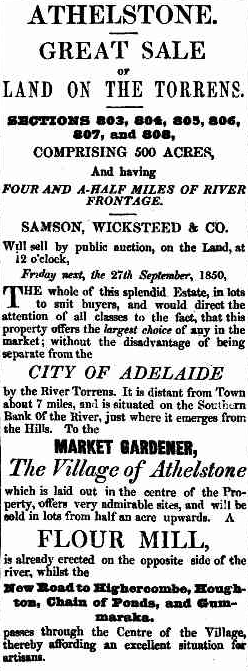
In 1847, William Pinkerton travelled overland with stock to the Port Lincoln district at Franklin Harbour, settling in a new estate. His family followed soon afterwards by ship (Evening Star, 1928). In 1850, the Studley Estate, in the newly named Village of Athelstone, was offered for sale (Adelaide Times).
Life on the property at Talia Station, Lake Newland (Port Lincoln Times, 1984) was perilous. Rachel later recalled her father’s experience, writing '… his life was a torture – no security of life and limb. He had many cases of robbery, despoliation and murder as well' (Reynolds, 1929). The isolation and instability of the district ultimately prompted the family to seek a new beginning.
In December 1854, William Pinkerton purchased the brig 'Amherst', to transport his family and livestock to New Zealand. They arrived in 1855 (Evening Star, 1928) following a journey Rachel described as ‘a long and trying passage, out of both food and water for our sheep and selves'.
They found a home in Caversham (a suburb of Dunedin), while William Pinkerton proceeded to build a homestead (Brookside) on the Brooksdale run at Tapanui 150 km west of Dunedin (Reynolds, 1929).
New Zealand
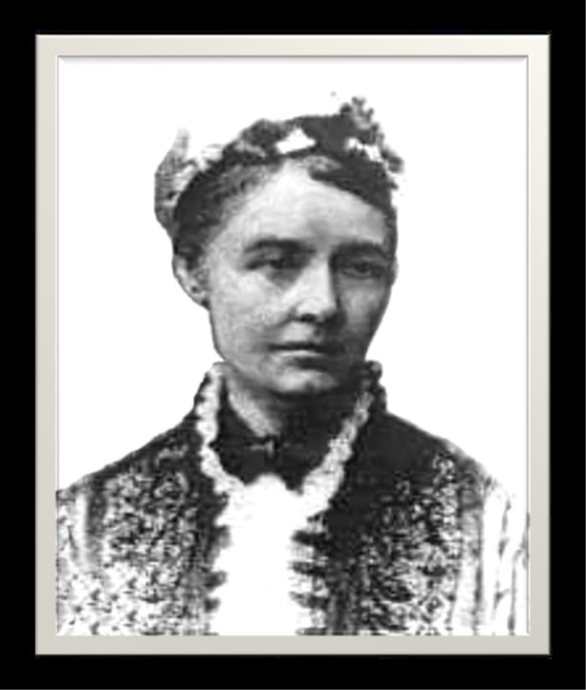
In 1856, aged 17, Rachel Pinkerton married William Hunter Reynolds, merchant and member of Otago’s Provincial Council (Evening Star, 1928). The marriage marked the beginning of a new chapter in Rachel’s life and a close partnership in both public and private spheres. William is remembered for his advocacy of the secret ballot and universal male suffrage during the 1870s, and he later served on the New Zealand Legislative Council from 1878.
In February 1857, William and Rachael Reynolds travelled to London aboard the ship 'Gil Blas' to recruit immigrants for New Zealand. Their eldest daughter was born in London on 26 August 1857. The couple went on to have nine children, five daughters and four sons (Page, 1993).
Throughout their marriage, Rachel worked alongside her husband as an active and capable partner. She acted as hostess at political functions and contributed substantively to public initiatives, including involvement in events such as the Intercolonial Medical Congress of Australasia, held in Dunedin in 1896 (Page, 1993).
William shared and supported Rachel’s deep commitment to social justice. Together, they frequently engaged in reform movements and civic campaigns. Between 1864 and 1871, Rachel worked with Learmonth Dalrymple to campaign for the establishment of a girls’ secondary college in Dunedin - the first public secondary school for girls in New Zealand - and for women’s admission to the University of Otago (Page, 1993).
Rachel Reynolds was also involved in founding the Dunedin branch of the Women's Christian Temperance Union and was active in political advocacy on women’s issues, particularly suffrage and education.
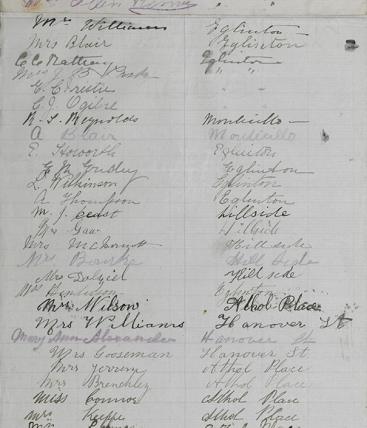
From 1889, Rachel played a leading role in initiatives advancing the welfare and rights of women and children. She served as the first President of the Dunedin Free Kindergarten Association and was appointed Vice President of the Women’s Franchise League (Dunedin), supporting the extension of voting rights to women. She was a signatory to the Women’s Suffrage Bill, with her name recorded seventh on the petition document (New Zealand Kindergartens, n.d.).
Following the death of her husband, William Hunter Reynolds, in 1899, Rachel Selina Reynolds emerged as one of Dunedin’s most respected advocates for women and children. She became a leading figure in the city’s free kindergarten movement and a tireless campaigner for early childhood education.
Committed to the principle of universal access, Rachel travelled extensively throughout Britain, Europe and the United States to promote the establishment of free kindergarten services. Upon her return, a journalist from the Otago Daily Times (1908) recorded her reflections on sustained advocacy:
“I strenuously preached free kindergarten. Don’t expect results in one year, or in two years but keep working away, and in twelve or fifteen years the progress made will astonish you.”
Rachel Reynolds, alongside private schoolteacher Lavinia Kelsey, was instrumental in establishing New Zealand’s first kindergartens (First Kindergartens, n.d.). Her leadership, vision and perseverance helped lay the foundation for a movement that would shape early childhood education nationwide.
In 1913, the Rachel Reynolds Kindergarten was opened on the corner of Dick Street and Macandrew Road, Dunedin, as a tribute to her dedication and service to children and families.
Rachel Reynolds died on 21 August 1928 at her daughter’s home in Dunedin, leaving a lasting legacy in education, social reform and community leadership.
References
(1841) To be Sold by Private Contract, Southern Australian, 27 August, p. 2, accessed 10 Feb 2026.
(1844) Valuable Stock for Sale, South Australian Register, 17 February, p. 1, accessed 10 Feb 2026.
(1844) Grapes, Apples, Pears, Sweet Melons, Water Melons, Fruits, Vegetables, and Bouquets, Adelaide Observer, 17 February, p. 4, accessed 17 Feb 2026, http://nla.gov.au/nla.news-article158918241
(1844) The Dinner, Southern Australian, 2 August, p. 2, accessed 17 Feb 2026,
1892 Women Suffrage Petition Roll - Sheet 399 - Region: Auckland, Coromandel, New Zealand archives. New Zealand History, (Manatū Taonga - Ministry for Culture and Heritage), accessed 10 February 2026.
(1893) The Toilers of the Hills., South Australian Register, 15 July, p. 6, accessed 10 Feb 2026.
(1850) Athelstone. Great Sale of Land on the Torrens, Adelaide Times, 24 September, p. 2, accessed 20 Feb 2026.
1908 Free Kindergartens. Otago Daily Times, 26 December 1908, p. 4, accessed 20 Feb 2026.
(1928) Death of Mrs Reynolds, Evening Star, Issue 19951, 22 August 1928, Page 5, accessed 10 February 2026.
(1929) Pioneering Romance, The Chronicle, 12 September, p. 51, accessed 10 Feb 2026.
(1984) From the Diary of an Old Bushman, Port Lincoln Times, 15 February, p. 6, accessed 10 Feb 2026.
Bethel K and May H (2017) Growing a kindergarten movement in Aotearoa New Zealand: Its people, purposes and politics, NZCER Press, accessed 10 February 2026.
Dunedin Kindergarten Association (2025) Rachel Reynolds Kindergarten, NZ Kindergartens, accessed 10 February 2026.
Family Search (2026) William Pinkerton 7 December 1810 – 27 February 1893, Family Search, accessed 10 February 2026.
First kindergartens (n.d.) URL: New Zealand History, (Manatū Taonga - Ministry for Culture and Heritage), accessed 10 February 2026.
New Zealand Kindergartens (n.d.) Rachel Selina REYNOLDS, nee Pinkerton (Mrs W H Reynolds) [1838 – 1928] 1st President DFKA Life member DFKA, accessed 10 February 2026.
Page D (1993) Reynolds, Rachel Selina, Dictionary of New Zealand Biography, updated January 2012, Te Ara - the Encyclopedia of New Zealand, accessed 10 February 2026.
Passengers in History (n.d.) Eleanor Pinkerton, South Australian Maritime Museum website, accessed 10 February 2026.
Reynolds R (1929) Pioneering in Australia and New Zealand: incidents in the life of the late Mrs W.H. Reynolds, Dunedin NZ, as recounted by herself, National Library of Australia, accessed 10 February 2026.