

Captain Thunderbolt
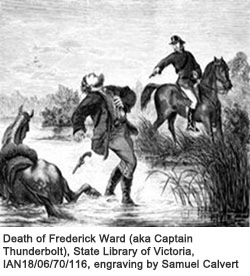 Since the early days of settlement until the latter part of the 19th century, bushrangers have been a part of life in Australia. The problem was restricted to the eastern states. They began with the convicts who were transported here and managed to escape from captivity. They used their survival skills to remain at large and were not averse to robbing and stealing to exist and to maintain their freedom. They were the original bushrangers. In 1866, the fear of bushrangers came to the Campbelltown area.
With the discovery of gold in the 1850s and the fever that ensued, highway robbery became a constant fear around the gold fields. This practice spread around the country as unsavoury characters realised they could live off these ill-gotten gains. It was the ordinary travelling public who became the target of the bushrangers as well as the gold transporters. One such brigand went by the name of 'Captain Thunderbolt'. His deeds were widely reported in the press.
He was considered one of the most successful and created great panic in the eastern states. Naturally, the law enforcers at the time were anxious to catch this fugitive from justice and were on high alert for any hint of an appearance and a chance to apprehend the criminal.
 So you can imagine the panic when a crime is committed in South Australia by a criminal who called himself 'Captain Thunderbolt'. Could it be the real 'Captain Thunderbolt' who has expanded his territory from the eastern states to South Australia, or did South Australia have an imposter? Was he trading in on the well-known name to strike fear into the travelling public of the state? That was the dilemma that faced the newly formed South Australian Police Force. The first indication of the gang was a robbery at Gawler towards the end of April 1866.1 The reason why the robbery took place at Gawler was to be answered after the gang had been caught. One of those arrested lived in Gawler, as did the married sister of two of the others in the gang. Further hold-ups, by the same gang, were reported at Unley, Prospect, and Adelaide. The final hold-up that led to the arrest of the gang took place at Payneham. That robbery led to the arrest of the gang, said to be led by 'Captain Thunderbolt'.
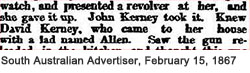 It is not clear how the police came to search the home of their suspects. It may be, as was stated during the trial, that the victim of the Payneham robbery (Mrs Taylor) recognised one of them who had visited her on a previous occasion2. He visited her with a young man named Robert Allen, who did occasional work for her. She recognised his voice even though she thought he had something in his mouth on the night of the robbery. She also stated that the same person had attempted to gain entry to her home on a previous occasion but was unsuccessful. Again, she stated she recognised the voice. This may be the reason the police searched the home of David Kerney, his older brother John Kerney, and their friend Thomas Field of Gawler. It was during these searches that not only were items found that had been stolen, but also implements used in the robberies. These implements included guns, clothing, and disguises, as well as a horse used in one robbery.3 The items taken in the robberies were found in a number of locations; some were hidden. Parts of a watch and casing were found in a well at the home of Thomas Field. Three other accomplices were considered suspects but were cleared after further investigation. One of them was Robert Allen, the boy who had taken David Kerney to the house of Mrs Ann Taylor at Payneham. The other two accomplices were Thomas Creamer and John Martin, who was a resident of Wallaroo.
The trial was held in February 1867 in the courthouse that stood where the Adelaide Post Office now stands. Thomas Field pleaded guilty and turned witness against the Kerney brothers, both of whom were also found guilty. They were all sentenced to hang, but this was commuted to a life sentence with hard labour.
Two of the guilty three were married. Thomas Field was married to the sister of the Kerney brothers. He had also lodged for a time with Henry Hersey, a noted diarist and recorder of the history of Athelstone. Henry Hersey attended the court as a friend of Thomas Field and noted this in his diaries. John Kerney was married to Annie Fry of Athelstone. The father of the Kerney boys, John Kerney Senior, was a well-known businessman in Adelaide. His cabinetmaking business was in Hindmarsh Square. After the imprisonment of her husband, Annie Kerney was unsuccessful in a court action against John Kerney Senior in an attempt to get financial support for her daughter, his granddaughter.
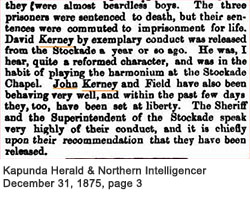 After approximately 8 years jail, the three members remembered in South Australia as the 'Captain Thunderbolt' gang were released. Instead of being fierce-looking men, at their trial they were almost beardless boys, one member of the press noted. As can be seen by this entry in the Kapunda Herald, the prison authorities believed all three had reformed and conducted themselves in an exemplary manner whilst in prison.4 The Sheriff and the Superintendent of the stockade both spoke very highly of their conduct, and their release was due to the recommendation of these individuals.
This whole episode was a matter of pain and embarrassment for all concerned. When notice of the arrest was posted, it stated John Kerney, cabinetmaker of Adelaide. Many thought it was John Kerney Senior who had been arrested. The local press duly printed an apology for any misunderstanding. John Kerney Junior was also a cabinetmaker; he worked for his father, and also lived in Adelaide. David Kerney moved interstate and made an unsuccessful suicide attempt whilst intoxicated.5 Not a lot is known of Thomas Field after these events. Some innocent persons were arrested and jailed for these crimes, then released when these three men were found guilty of the crimes supposedly committed by them. Some people believe the Kerneys too had crimes attributed to them that they had not committed. It is said that John Kerney Senior was never the same man again, which is understandable. John Kerney Junior died of a paralytic stroke at the Adelaide Hospital on 1 August 1892. Annie Kerney (nee Fry) went on to marry a further three times and died peacefully, aged 85 years at Marden in 1932. She is buried at the Athelstone Independent Cemetery as Annie Oldland, together with their two daughters.
At the time of these robberies, editors received letters purporting to be from the real Captain Thunderbolt (Frederick Wordsworth Ward) stating that these robberies were not his work. Even before the arrests, these letters were being sent by an indignant 'Captain Thunderbolt'. The real 'Captain Thunderbolt' died in a shootout with police, so we are still not sure if it was the real bushranger who was upset by these 'weak crimes' as he intimated in his letters to the editors. Although some crimes were committed in South Australia in his name, we can be sure it was not the same 'Captain Thunderbolt' who brought terror to the people of New South Wales.
Researched and compiled by Jim Nelson, a volunteer with the Campbelltown Library 'Digital Diggers' group.
References
- 1866 'GAWLER.', The South Australian Advertiser (Adelaide, SA: 1858 - 1889), 1 May, p. 3, viewed 2 June 2015, http://nla.gov.au/nla.news-article28787053
- 1867 'SOUTH AUSTRALIA.', The Brisbane Courier (Qld: 1864 - 1933), 16 March, p. 6, viewed 3 June 2015, http://nla.gov.au/nla.news-article1281560
- 1866 'CESSATION OF IMMIGRATION.', Bunyip (Gawler, SA: 1863 - 1954), 10 November, p. 2, viewed 3 June 2015, http://nla.gov.au/nla.news-article130959926
- 1866 'POLICE COURTS.', South Australian Register (Adelaide, SA: 1839 - 1900), 9 November, p. 4, viewed 3 June 2015, http://nla.gov.au/nla.news-article41018140
- 1875 'CITY CORRESPONDENCE.', Kapunda Herald and Northern Intelligencer (SA: 1864 - 1878), 31 December, p. 3, viewed 3 June 2015, http://nla.gov.au/nla.news-article108370063
- 1895 'THE MERCURY.', The Mercury (Hobart, Tas. : 1860 - 1954), 23 September, p. 2, viewed 3 June 2015, http://nla.gov.au/nla.news-article9337972
- 1867 'THE TWO KERSEYS.', South Australian Register (Adelaide, SA: 1839 - 1900), 16 February, p. 2, viewed 3 June 2015, http://nla.gov.au/nla.news-article39188469
- 1866 'POLICE COURTS.', South Australian Register (Adelaide, SA: 1839 - 1900), 13 November, p. 3, viewed 3 June 2015, http://nla.gov.au/nla.news-article41021811