

Adelaide Hunt Club in Campbelltown
The Adelaide Hounds 1840-1869
One of the earliest reports of a meeting by the Adelaide Hounds was published in July 1842. The hunt met at Walkerville, and three kangaroos were the targets for the hounds as foxes were not common in the colony of South Australia at the time.1 Just a year later, it was reported that:
A large fox was turned down near the iron stores. The hounds were a little wild at first, in consequence of the scent laying ... badly, from the heat of the day-the meet being later than usual, on account of the levee at Government House. In a short time, however, they took up the scent, and after a good run of about five miles, killed their fox in good style in the open near the half-way house to the Port. Our fellow townsman, Mr Williams, carried off the brush.2
Dingoes were often the quarry, but it was not until the 20th century that more humane methods were used, such as 'an aniseed soaked cloth on the hoof of a lead horse'.3
The Adelaide Hunt Club 1869-1900
The Adelaide Hunt Club was formed in May 1869. The first master was Mr William Blackler, with the governor Sir James Fergusson nominated as President. Hunts, Adelaide Hunt Club racing events and social events such as formal hunt balls were held regularly, featuring notable Campbelltown residents and properties.
Hunting in Campbelltown
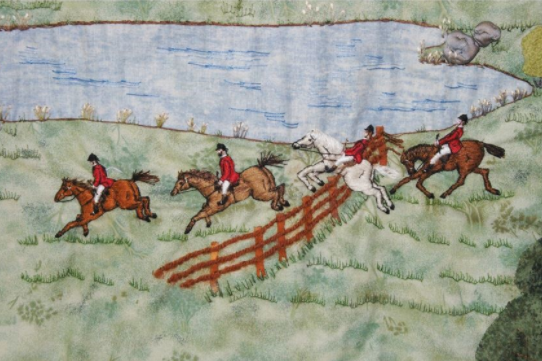
Illustration from the City of Campbelltown Links Wall Hanging, located in the Campbelltown Public Library foyer.
In 1872, Mr H. E. Downer was the master of the hunt and an early report of the Adelaide Hunt's activities in Campbelltown is so eloquently described in 1870 that you could almost feel as though you were present.4
... If Saturday's run did not, like that one celebrated in the hunting annals of 1861, cross three rivers and pass through 19 parishes, at all events it crossed one river three times, and gave a deal more stiff and uncompromising cold-blooded timber than ever falls to the lot of those who follow in regions north of the Line. No run could so well illustrate what is necessary in a hunter here. He must be a resolute horse resolutely lidden (ridden), with power to jump high and clean, rather than far and clever. We should say, to put it concisely, hands and head there, pluck and seat here, are the relative necessities in the riders. A greater treat than such a line as Saturday's, with a horse equal to the occasion, is one of the things to be treasured in the memory of a lifetime. For the country selected, and the permission given, without one exception, and with the greatest cheerfulness, the Club is indebted wholly to Mr Downer...
At 1 o'clock Mr Downer entertained his friends at a capital luncheon at his residence, Campbelltown; and at 2 the field mustered at the Glynde...
The hounds were laid on in Mr Cornish's paddock, opposite the Glynde. They quickly found and raced away, leading through Mr Jones's and Mr Macdonald's, over some regular raspers, which made the chapter of accidents commence very early. Thence they went for the river, and, crossing and recrossing three times in all ; came out of the valley and up a steep hill, which made the heavy timber at the top on each side of the road none the easier for blown horses, and thicker and faster cams grief and disaster. Crossing the road by McLeod's, they sailed over a couple of fences into the main road from Paradise, and over a fence into grass on the right over another into Kingsmill's, and so for the hills, not losing a fence by the way, and they were plentiful as blackberries, the whole of the run from the river close up to Anstey's Hill being a severe ascent, and the fences regular smashers, the ground, too, towards the finish deep sand. Falls there were and to spare. Mr Malcolm came twice to grief—on one occasion his horse getting hung up in wire, and having to be "axed" out. Boase had a mount on Launcelot (the Master taking escort duty, and not following straight), who within a few minutes gave him two tremendous falls, but through the rest of the run fenced magnificently, taking some of the biggest with a foot to spare, and not touching again. Mr Downer, on Pathfinder, was to the front throughout, nothing stopping him, and Mr Mann, on Forester, went straight as an arrow and clean as a bird. Mr C. B. Young, on his grey, was in the first flight all through, and Mr Darwent, jun., a young gentleman of the mature age of 12, weighing a trifle over four stone, and on the big Roachy resembling a fly on a round of beef, in his own language, " let him rip" at everything. Mr Horton was well served by Problem, who carried him as if quite equal to the weight, the ground, and the jumps. The run was not the fastest, but certainly the heaviest and severest for fencing of the season.'5
The Express and Telegraph Monday 10 July 1882, page 4 reports on the hunt that took place through Mr Mildred’s property at Glynde, then through (Thomas) Moyle’s (Orange Grove, Magill) and Mr Swan’s (Stradbroke) lands with the finish line on the property of Mr Ross Reid. While in 1885...
Mr Charles Downer, a son of a former Master, turning his knowledge of the country to account, and having a good horse (Swordsman) under him, got to the pack after some considerable time, and managed to get them to hit the line, which they held with some trouble, owing to the field and one couple having been over it and the scent being nearly effaced, and turned up with them, while horses were being led about. Not a hound was missing when they left Mr Swan's for the kennels. Mr Smith, the Manager at Rostrevor, very kindly took out wire and put in saplings to open a way into Mr Reid's, and trimmed the hedges to avoid injuries from stubs and stakes.6
Other landowners in the Campbelltown region were also happy to allow their properties to be used for the Hunt. The routes appear to have been about 12 miles (19.3km), jumping over approximately 40 fences. A truly graphic description of the hunt on Saturday 8 August 1885 was reported in the South Australian Register (Adelaide, SA: 1868 - 1881) Monday 10 August 1885, p 7.
On Saturday (8 August 1885) the hounds met at Stradbroke by invitation of Mr Swan, and a summer day had the effect of filling the grounds with quite a crowd of visitors. This is the third time during the present season that the fields of Stradbroke and Rostrevor have been turned to account, and there is no more favourite bit of hunting country, for the turf affords splendid going and a good take-off and landing at each fence, while the scenery and view is among the finest to be got in the neighbourhood of the city.
This article continues with a detailed description of the Hunt through the various properties in the area, illustrated below by the map of the route. The article is worth reading in full as it eloquently describes the action of the day.7
In summary, the weather was good but with a north-east wind which made for ‘a bad day for scent, and very trying for hounds. Members were invited for half an hour before the throw-off, and on arrival found tables spread in the garden to refresh the inner man’. Women were only invited as spectators at this time!
The route went ‘up the slope towards Rostrevor, and then wheeling to the right pointed for Mr Reid's paddock, which an ordinary wire and top rail divides from Mr Swan's.’ Then, ‘down the slope and over the hedge. Swinging to the whip-hand they led back into Stradbroke over a hedge with a fence in it, and ditch on the take-off, and wheeling sharp to the left rattled it through the trees, over a big fence, across a brook, and on to good grass beyond.’ Heading east, ‘they popped over a fair-sized fence, and then some splendid galloping ground, over a couple of fields with a goodish dividing fence, brought them to the four cross roads through opened wire...towards Marybank.’
Here the Hunt ‘carried it straight away over a low bit of timber, thence out into the Athelstone road over another bit, and turning into a lane by the stone wall jumped a good fence, taken at a sharp angle, and went through some wild country of Mr Fox's.’ Through some water, ‘crossing a stream with very rough banks, and checked by the Athelstone crossroad. After some ten minutes they moved off again, down the road which leads to Campbelltown, and leaving this when past the reservoir, turned down a long grassy road towards the river, in the direction of the Highbury ford.’
Turning south-westerly up a lane, through open ground to the right, then ‘over some grass-land to a regular rasper, with posts like stockyard posts and rails like ordinary posts, which, by-the-way, as usual with a big uncompromising fence that won't give, was jumped cleaner and better than most of the fences before it. Holding the line still west they crossed more grass and topped a good honest bit of timber, and then turned south, getting into the road over a low jump where the Magill crossroad touches the Campbelltown road.’
‘Running up the roadside to avoid crop they went in over the fence on the right to Mr Mundon's’...the hunt proceeded to Ross Reid's at Rostrevor, ‘finishing over the fence into Stradbroke.’
The article concludes with thanks to Mr Swan for his hospitality and provides an insight to what was involved for landowners to allow the hunt through their properties.
Shifting of sheep, altering fences to make them jumpable, opening wires, sacrificing no small amount of grass, may be alluded to as some of the consequences of inviting the hounds; and it is only the commonest justice to bear testimony to the ready manner in which all the landowners give their aid to the sport, in not a few cases themselves repairing damages to fences. The assistance which Mr Ross Reid gave year by year is continued by his manager, Mr Smith, who is always ready to go out of his way to find more country. To Mr Fox, of Marybank, Messrs. Sanderson, Ind, Gameau, and Mundon, we must always record great obligations, without whom this favourite line could not be hunted.
The Ghost Huntsman
There is a local legend that a huntsman haunts Gurners Reserve. You can read more about the Ghost Huntsman and other paranormal events in our Ghosts of Campbelltown local history article.
Map showing the Hunt on Saturday 8 August 1885, illustrating the properties and landmarks through which the Hunt progressed.
Researched and compiled by Di Booker, a volunteer with the Campbelltown Library “Digital Diggers” group.
References
- 1842 'The Adelaide Hunt', Southern Australian (Adelaide, SA: 1838 - 1844), 22 July, p. 3. , viewed 07 Sep 2017, http://nla.gov.au/nla.news-article71621725
- 1843 'LOCAL NEWS.', Southern Australian (Adelaide, SA: 1838 - 1844), 26 May, p. 2. , viewed 07 Sep 2017, http://nla.gov.au/nla.news-article71617015
- 1989 '10 years ago', Times (Victor Harbor, SA: 1987 - 1999), 26 May, p. 9. , viewed 07 Sep 2017, http://nla.gov.au/nla.news-article190892954
- Illustration from the City of Campbelltown Links Wall Hanging. Located in the City of Campbelltown Public Library foyer
- 1870 'Adelaide Hunt Club', Evening Journal (Adelaide, SA: 1869 - 1912), 12 September, p. 3. (LATE EDITION), viewed 07 Sep 2017, http://nla.gov.au/nla.news-article196734062
- 1885 'Adelaide Hunt Club', South Australian Register (Adelaide, SA: 1839 - 1900), 22 June, p. 3. , viewed 07 Sep 2017, http://nla.gov.au/nla.news-article44529471
- 1885 'The Adelaide Hunt Club at Stradbroke', South Australian Register (Adelaide, SA: 1839 - 1900), 10 August, p. 7. , viewed 07 Sep 2017, http://nla.gov.au/nla.news-article44945570
- Daly, John A, 1986, The Adelaide Hunt: A history of the Adelaide Hunt Club 1840-1986 Adelaide, Adelaide Hunt Club with the assistance of the South Australia Jubilee 150 Board and The Australia Council Literature Board.